Wednesday, October 5, 2016

Plot Ingredients

Where do fiction writers get their story ideas? Well, I can tell you where I did, and based on what I’ve read, many writers take a similar approach. Here’s the recipe:

  • Take at least one real-life experience.
  • Combine it with headlines (past or present).
  • Throw them into a mental Mixmaster.
  • Add buckets of imagination.

Then, if you’re clever, creative and lucky, you come out with a compelling plot.

Drug-assisted sexual assault informs my story as do the headline-making accusations against Bill Cosby. By mashing up these events with research into psychopathic behavior and the unsolved Gilgo Beach, Long Island, serial murders, voilĂ , a psychological thriller emerges.

Lost Girls by New York Magazine contributing editor, Robert Kolker, was especially helpful in its examination of the murder victims’ lives through interviews with their families and friends. The first of ten bodies was discovered in December 2010. All were online escorts who had been strangled, their bodies wrapped in burlap sacks before being dumped along Gilgo Beach. The consensus of investigators was that all were killed elsewhere.

Stephen King has said, “I get my ideas from everywhere. But what all of my ideas boil down to is seeing maybe one thing, but in a lot of cases it’s seeing two things and having them come together in some new and interesting way, and then adding the question, ‘What if?’ ‘What if’ is always the key question.”

Here’s my ‘What if?’:

What if an employee suspects her company’s CEO of sexually violating a female co-worker, and a week later sees him among onlookers at the murder scene of a prostitute?

To these circumstances, I added the CEO’s fragile wife who also makes disturbing discoveries about her husband. Stephen King’s brilliant short story, “A Good Marriage” in Full Dark, No Stars, was the inspiration for this character and chilling sub-plot.

I threw in a handsome detective, charged with investigating the long-standing serial murders, to add tension–romantic and dramatic–as the story’s heroine goes down treacherous paths with shocking outcomes to expose the CEO and validate her suspicions.


Monday, September 12, 2016

Truth Is Stranger Than Fiction

My writers workshop kept me on the straight and narrow while working on The Incident, my first novel. I was encouraged to write often, every day in fact. And every week, I read my work to the other participants–smart people, some already published, some aspiring authors, but all contributing insights that either validated mine or offered new ones I hadn’t considered. After almost three years, I have put together approximately 80,000 words, comprising some 330 pages, to create a psychological thriller. (Now all I have to do is find a literary agent and publisher - even more difficult than writing it!)

One of the things that struck me during my workshop sessions was when someone in the group questioned a particular situation or character in my story. I would often say, “But that really happened.”

So what?” was the response. “It’s not believable.”

As Mark Twain said, “Truth is stranger than fiction, but it is because Fiction is obliged to stick to possibilities; Truth isn’t.”

This supposition sent me back to the drawing board more than once to rewrite scenes or characters into more realistic, albeit fictionalized, versions of the truth so readers would find the story credible.

One of the main characters in my story is made CEO of a company without having significant prior business experience. While in reality, this can happen (and does), my workshop colleagues cried foul and said that won’t fly. So I wrote that development in such a way that made it more plausible. The newly appointed CEO became the company owner’s son-in-law.

Here’s a related excerpt from the book:

What would you think about taking over?” said Herbert. “Not permanently, but at least for a while. I need someone to pull in the reins over there. Monk spent money faster than my ex-wife.”
Herbert’s eyes drilled into his son-in-law’s looking for a sign of hesitation. He saw none. Becker’s face was a cement barricade, as always. It was one of the things he liked most about the German since he had insinuated himself into life on the estate and Wirth Holdings through his sharp mind, competence and loyalty. Whatever emotions Becker had were kept in his private, unassailable vault, and Herbert saw that this occasion was no different.


Nepotism allows this circumstance to become conceivable.


Monday, August 8, 2016

Faith Restored


On the way to my father’s house yesterday, I hit a car on the Merritt Parkway. The good news is, no one was hurt. The bad news is, there was some damage to the rear bumper of the car I hit. The good news is that I wasn’t on my phone talking or texting. The bad news is traffic was backed up, I took my eyes off the road for an instant, kept moving, albeit at a slow speed, but enough to hear that horrific crunching sound that sends shivers through every pore of your body.

We were able to easily pull our cars over into a wide swath alongside the Merritt, avoiding messing up traffic any further and outraging the other drivers on the parkway. We exited our vehicles to assess the damages.

Now for the best news. The young man driving the car I hit immediately put his arm around my shoulders and said, “Don’t worry, I’m a happy person.”

OMG, I was shocked. I said, “I’m a happy person too and you are a sweetheart.”

We chatted, looked at our cars, mine was essentially untouched, but his would need some repair.

Since it was his father’s car, he called him to get guidance. He told his son to get my information and take photos of my license, insurance and registration. I also gave him my card with phone number and email address. Then his father asked to speak to me. He was as pleasant and understanding as his son (not far from the tree, as they say). He asked if we were alright, agreed that going through insurance would only jack up rates and that I would pay the repair cost directly.

The young man (whose name I failed to get) and I soon parted ways, but not before he cheerfully said, “I hope you enjoy the rest of your day.”

Since no one was close to being injured, it was almost worth bumping into the car so that I could meet this charming, polite young man. (Although I might not feel this way when I see the repair bill.)

In these turbulent times – politically, environmentally, socially, journalistically, spiritually, whatever – this young man restored something for me that has been missing of late. I think it may be a belief in the goodness of people.


Thank you, young man from New Jersey. I look forward to hearing from you and learning your name.

Wednesday, March 23, 2016

Diagnosis


It’s true, whenever I get sick, I anticipate the worst. Last Sunday night I got the stomach flu, or something along those lines, with the usual symptoms that keep you in the bathroom for quite a while. The recovery period lasted about 48 hours during which I ate nothing, and gladly dropped a few pounds (but not worth it). As I took to my bed with heating pad in tow, this down time allowed for reflection as to what was really underlying my malady. 

My dear friend’s husband has stage four pancreatic cancer. Her family and closest friends have rallied to support her as she has made a valiant effort to honor his request to be at home for the duration. As an observer of his devastating decline and occasional participant in his care, I found it hard to believe by Monday morning that I too had not contracted pancreatic cancer. After all, did I not have similar symptoms as to what he originally experienced before his diagnosis? 

Several other possibilities occurred to me as I lay in bed, sending Tim out to get ingredients to meet my curative requirements, including buying and grating fresh ginger for tea. It could be appendicitis, a kidney stone, even a heart attack. I looked up every one. Time to rule out, or in, the most dire outcomes.

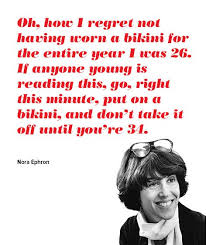
On Monday night, although certain death was imminent, I summoned the energy to watch the HBO special “Everything is Copy” about Nora Ephron’s life. If I was too sick to work on my own book, I could at least learn about an admired author and her process. Ms. Ephron passed away in 2012 of acute myeloid leukemia, the same rotten cancer that took my sister-in-law Patty’s life.  So naturally I wanted to watch, also because Ms. Ephron has been known to have keen observations about life and love, and as it turned out, death. 
 
Her version of AML gave her time to consider how she wanted to cope, and her decision was to keep her illness private, something I most likely will not do. (My recent end-of-life trauma was communicated to anyone who would listen.) The program did inspire me to consider something she did in her final years. She made a list of things she would miss, and those she would not. In discussing this with a friend, I said that this seemed a useful exercise as it makes you appreciate what you have and to be grateful. He said, rather astutely I thought, it’s also a way to remove the clutter from your life. If you identify those things that you will miss, your focus can change and those items will rise to the top and hopefully you can drop the least important ones completely.  

Since it was becoming clear that my days were numbered, I started my own list and found many of the things I would and would not miss are the same, or at least similar to Ms. Ephron’s. I hope to hold this list in my mind always so that my remaining years will be clutter free. What I won’t miss is a short list, so I’ll get that out of the way: the news. 

Now, without mentioning the obvious people who have stayed with me for the long haul and hopefully know that without them my life would be meaningless, here are some of the things I will miss:
  • My house
  • Max and Rusty
  • A fire
  • Strawberry rhubarb pie
  • Bed
  • Aspetuck Reservoir
  • Pizza
  • Walking in the woods
  • Barley wine beer
  • The Joel Barlow track
  • Getting the Christmas tree

Hmm, Ms. Ephron was right.  Everything is copy.

Wednesday, March 2, 2016

The Year of Getting Serious About Writing


My first anniversary as a Westport Writers’ Workshop participant arrived this past January 12th. Since then I have attended every session they’ve held for fiction writers and have graduated to Advanced Fiction/Manuscript, my first workshop of 2016. 
 
After spending nearly three years trying to write a novel on my own, in a vacuum, it occurred to me that I needed help. A Mike and Molly episode (the one where she attends a writer’s workshop in Iowa) was the impetus for my revelation and charge into action. 

Not knowing a thing about workshops or what would be expected of me, right out of the box I found myself reading five pages of my long labor of love – out loud, in front of strangers. Since then, the continuing experience has saved me in more ways than I can count. But let me try:
  1. My writing has improved dramatically, and so say all including my stalwart workshop leader, who often provides line edits for weekly submitted pages that give me the most useful guidance and encouragement.
  2. I have met talented, intelligent and interesting fellow writers who never fail to amuse and entertain with their creative projects.
  3. The depression I experienced following my departure from a full-time, marketing communications management position nearly did me in. “Oh, how will I survive without the structure of 8-5 days and a hefty paycheck.” Not only have I survived on far less, but I have thrived on being master of my time, allowing me to live out my life as a writer, and attempt to assuage my desire to be an author.
  4. My book, based on a compilation of real-life corporate incidents and characters, is now over 70,000 words. I have written “The End” about four times, but as most writers know, there is always room for improvement, and my workshop colleagues lead me in new directions after every reading that improve my story and writing.
  5. I am learning all the time as I do research for my book, a psychological thriller, on homicide investigations, forensics, cellular technology, and the law – criminal, contract and employment.
  6. In order to make the setting as real and interesting as possible, I need to frequently visit the Boston area where my story takes place. Naturally, this includes dining at great restaurants and fun brew pubs.
  7. Because I want my book to be not only intriguing, but credible, I have had the privilege of meeting with a detective from New York who shared fascinating views into the real world of crime and investigation while answering all my questions to be sure my plot holds together.
  8. You don’t have to ask me twice to read good literature, and happily that is the advice every published author gives aspiring writers. I rarely leave the house without a book on CD cued up in my car, and a hard copy for when I’m not moving. 
  9. I wake up every day with a purpose and a goal to write at least a page if not a chapter. The value of the effort always depends on level of inspiration, and I am lucky to have that in abundance after every workshop.
  10. Sometimes we share personal experiences or challenges from the previous week (our intrepid leader has referred to our meetings as group therapy); we always share writing struggles, successes and breakthroughs; and best of all, we laugh, usually courtesy of a particularly funny story someone has written and read to an appreciative audience.

It’s been a full year of Mondays, a day I anticipate and prepare for all week because that’s when I meet with my group and talk about writing. As it turns out, that’s all the structure I need.

Friday, October 17, 2014

Blog About Blogging


I just had a fairly heated discussion with a colleague about why someone writes a blog. I’m talking about a business blog here, not a personal one to network, find a job, vent about an issue, or just share a challenging journey. The genesis for the debate we had was related to a blog this individual wrote for his company about an industry meeting he attended. He often runs his writing past me as a sanity check and proof reader basically. And also to come up with clever titles for his blogs. 

In this latest instance, I struggled to find the purpose of his dissertation and suggested he needed to understand who he wanted to influence with what he was writing; essentially what was the purpose of his words and who would he like his audience to be. Simple, clear writing, even about technical topics, is a good approach in my view to engage readers.

His response was, “The purpose of a blog is to get people to come and read it.”

I parried with: “No, the purpose of a blog is to get people to come back and read what you have to say repeatedly because you have proven yourself to have significant ideas and comments about a subject that matters to them.”

Ultimately, we may have been saying the same thing. In the course of a blog, the writer can demonstrate, among many things, his knowledge, expertise, ability to entertain and inform. A possible by-product of the blog, if you are representing a company, is that readers will look further into your company, its products or services via a search or your website to learn more because they have connected with you on a personal level.

It should never be a straight out product promotion, although many are. That’s what advertising is for, as well as your website and brochures. Since I’ve been in the marketing game for quite a long time (read: before the Internet), I liken a blog to a signed article where trade book editors typically cut out any attempt to blatantly promote your product. The point of a signed article, somewhat like a blog, is to share knowledge and insight about a specific topic. But as in any self-publishing endeavor, you get to use your own voice, be informal if you like and even entertaining.  You’re the final editor. And hopefully what you write is worth reading.

Sunday, July 27, 2014

LinkedIn Leads: Lessons Learned

Any worthwhile lead generation activity takes work. Usually a lot of it. And it can take a lot of time. First, build your database of individuals who can benefit from your product. And keep adding to it. You can do this through traditional marketing like webinars, direct/email campaigns, or purchased lists. But beware of lists as their data is often outdated and inaccurate. At one company where I worked, we employed three data verifiers to call people on a D&B list to validate information. For a small company, this is a pricey undertaking. Building your own list is going to be the best option.

Second, use social media (my preference is LinkedIn), to open up even more channels and broaden your reach to build relationships with people who you couldn’t meet anywhere else. Here are a few ways to do that:

Research LinkedIn Groups that have a relevant mission and members that would be most interested in solutions you offer. Once you join (and often you need to be accepted by the group leader), you can review the members, their titles and interests through discussions taking place.

Participate in those Group discussions where you can add valuable insight. You can begin to build your reputation, and your company’s in the process, as someone worth reading. Do not promote your product here.

Start discussions or lead them to information (including your company’s blog) that demonstrates your knowledge and value in your solution area or industry.

Invite contacts to connect with you. They can be those you’ve met or scanned at a show or conference, as well as those from an event’s attendee list.  Do the same with those who have attended one of your webinars. I keep track of those I’ve invited to connect on a spreadsheet to track progress and avoid duplication.

Tag connections to form “special” targeted groups. Once a contact is a connection, I tag them on LinkedIn assigning them to specific groups usually based on industry, company or area of interest for future communications.

Communicate useful, non-promotional information. This can include general information from trade publications or communities, event or webinar invitations, blog posts, including your own company’s blog since that should also be informative and non-promotional.

By the way, you can create your own company’s Group on LinkedIn and invite customers, prospects and employees to join. But be prepared to spend time creating useful content to make their visit worthwhile if you want to keep them coming back and engaging with you. Monitor and respond quickly to requests to join. Large companies can devote a full time resource to this effort. Smaller organizations who don’t pay attention to this risk losing visitors, and worse, good sales leads.